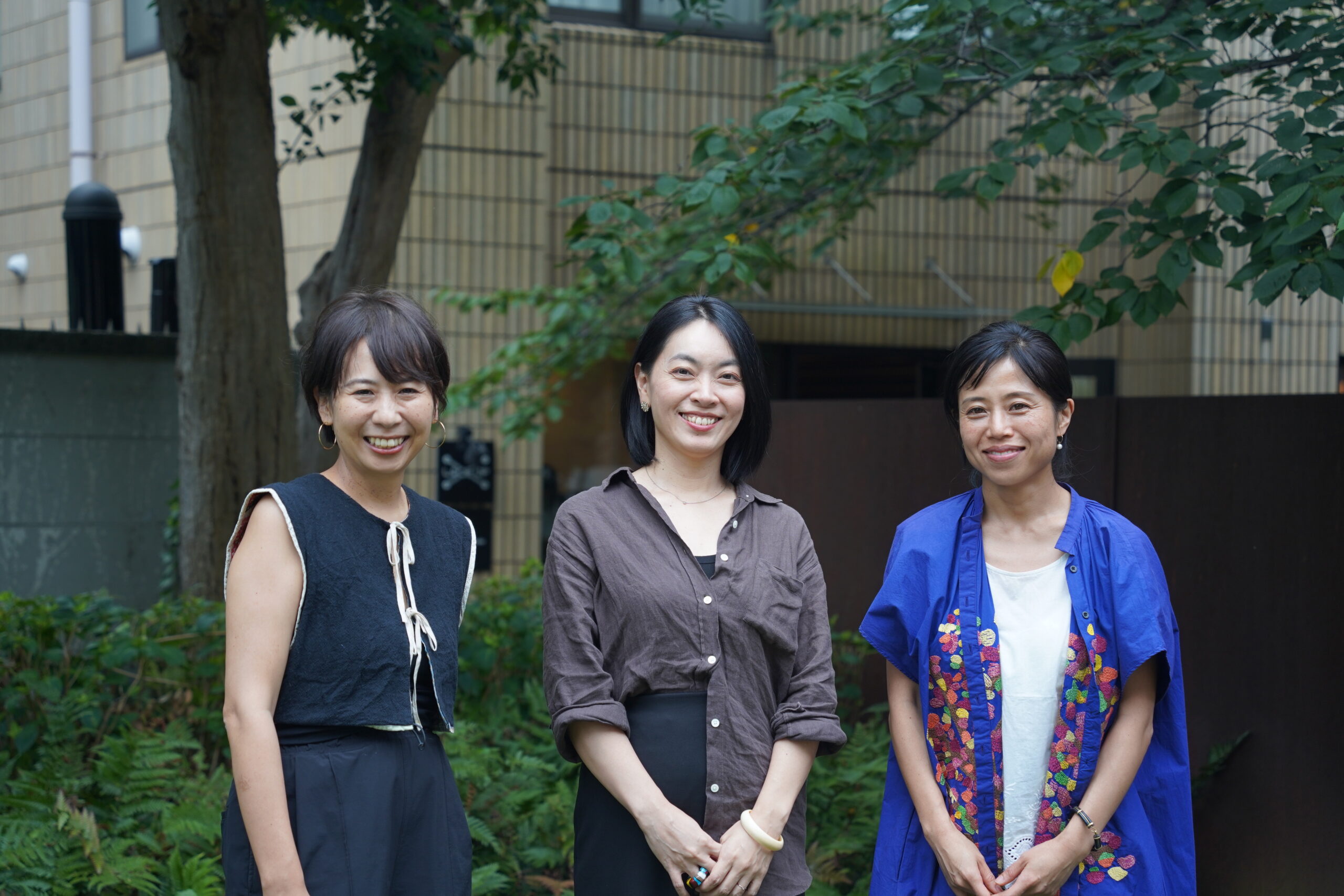
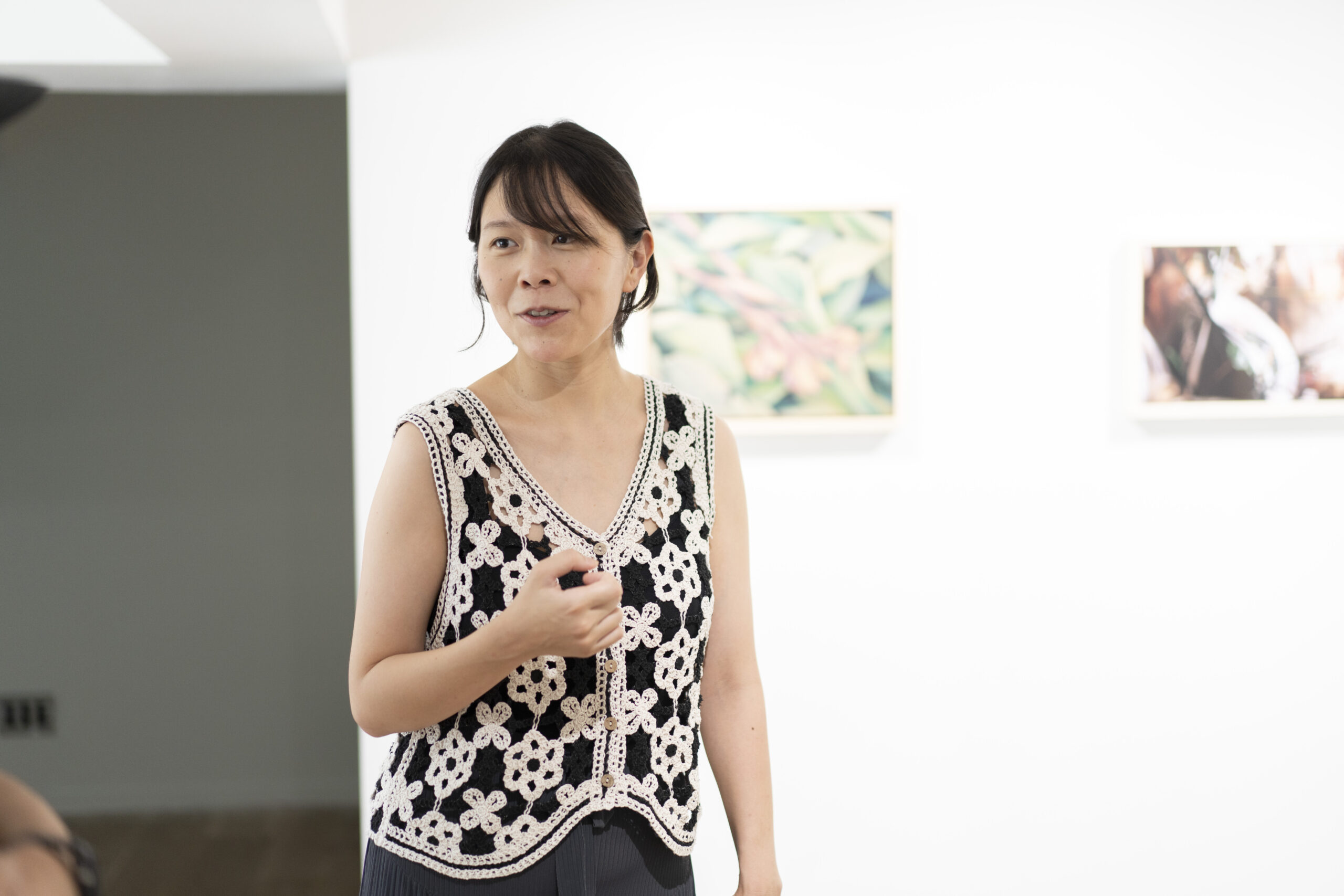
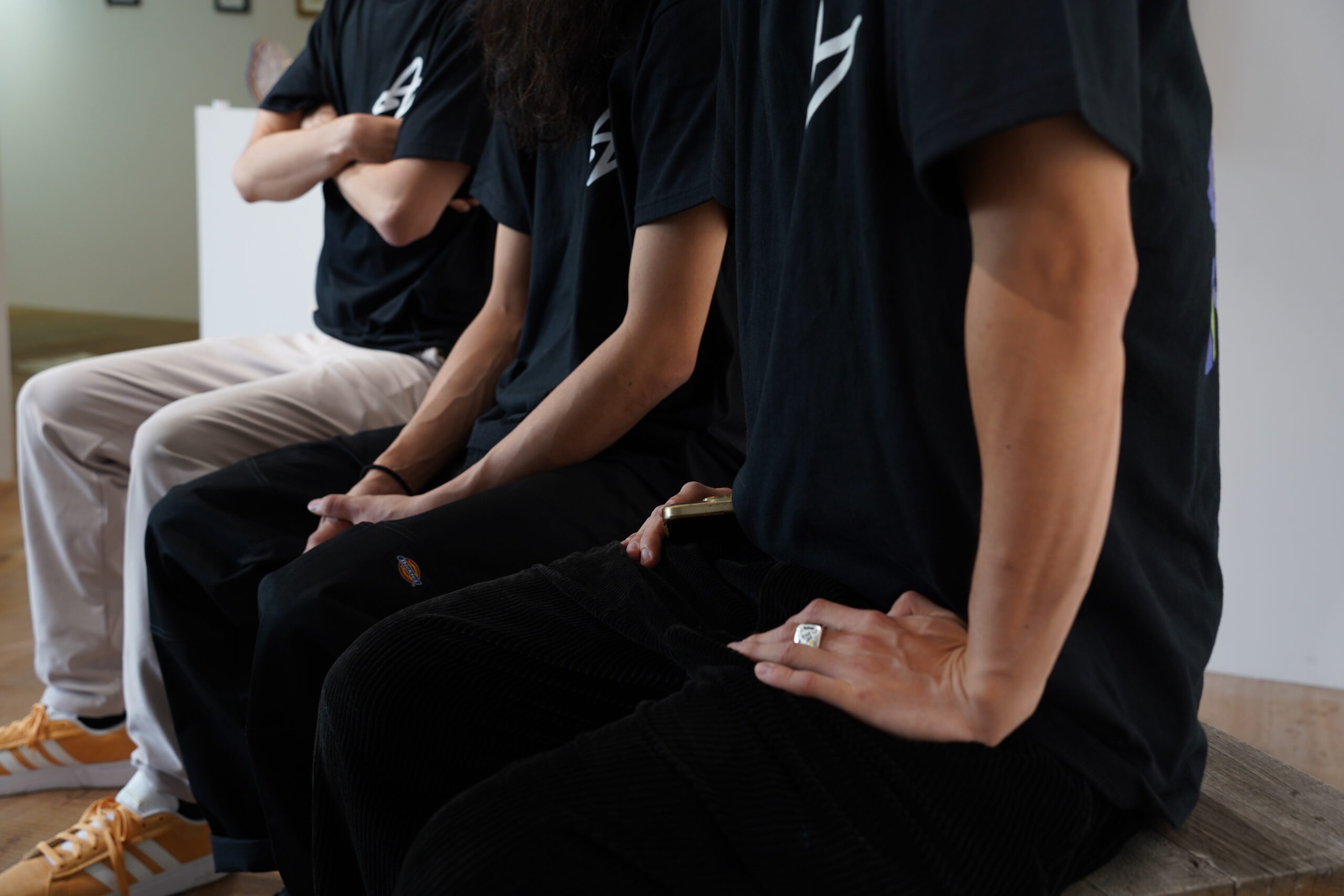
現在コートヤードHIROOガロウにて個展 「ENERGY DOSE ― collective immanence ―《エナジー・ドーズ》― 集合的内在 ― 」を開催されている花崎 草(はなさき かや)さんと、同じくコートヤードHIROOガロウでFlowers for urban maladies(都市に処方する花束) 2.0を開催されている塩原 有佳(しおばら ゆか)さんにインタビューをし、本展示などについてお伺いいたしました。
アーティスト:花崎 草へのインタビュー
Q: 自己紹介をお願いします。
Please introduce yourself.
A:花崎草(はなさき かや)と申します。東京藝術大学先端芸術表現専攻を修了後、パフォーマンスを中心に、インスタレーションなど様々な領域や媒体を横断しながら活動しています。現代社会の中で見えにくくなっているものに光を当てながら、観客や参加者の体験そのものを作品の一部とするアプローチなども展開してきました。日本とアジアを行き来しながら、国際的な文脈でも活動しています。
My name is Kaya Hanasaki. After completing the Department of Intermedia Art at Tokyo University of the Arts, I have been working across various fields and media—primarily performance, but also including installation art. I have developed an approach that sheds light on aspects of contemporary society that are often overlooked, while also incorporating the experiences of the audience and participants as integral parts of my work. I travel between Japan and other parts of Asia, and my practice is situated within an international context.
Q:今回の展示のテーマについて改めて教えてください。
Could you tell us again about the theme of this exhibition?
A:「人々が外側に求めるものは、すでにわたしたちの内側にある」というのがテーマの出発点です。わたしたちは愛や平和、悟りといったものを外側の世界に求めがちですが、そういったものはそれぞれの内側に見出すことができると感じています。東洋仏教で禅の達磨は「仏は外にあるのではなく、あなた自身の心の中にある」とし、密教の空海は「この身このままで仏になれる」と説きました。
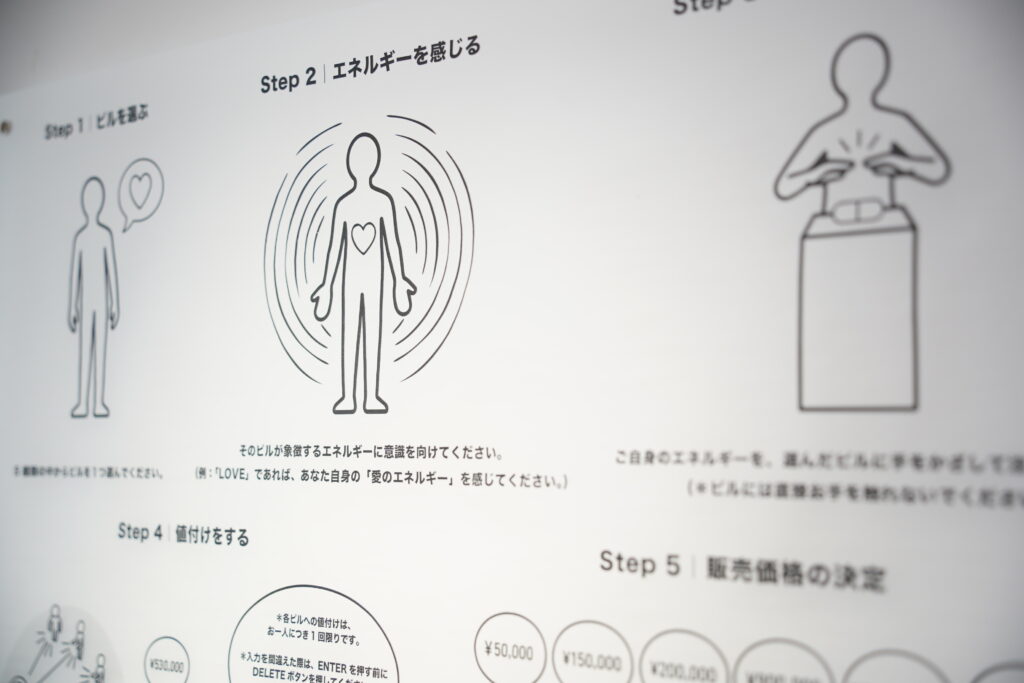
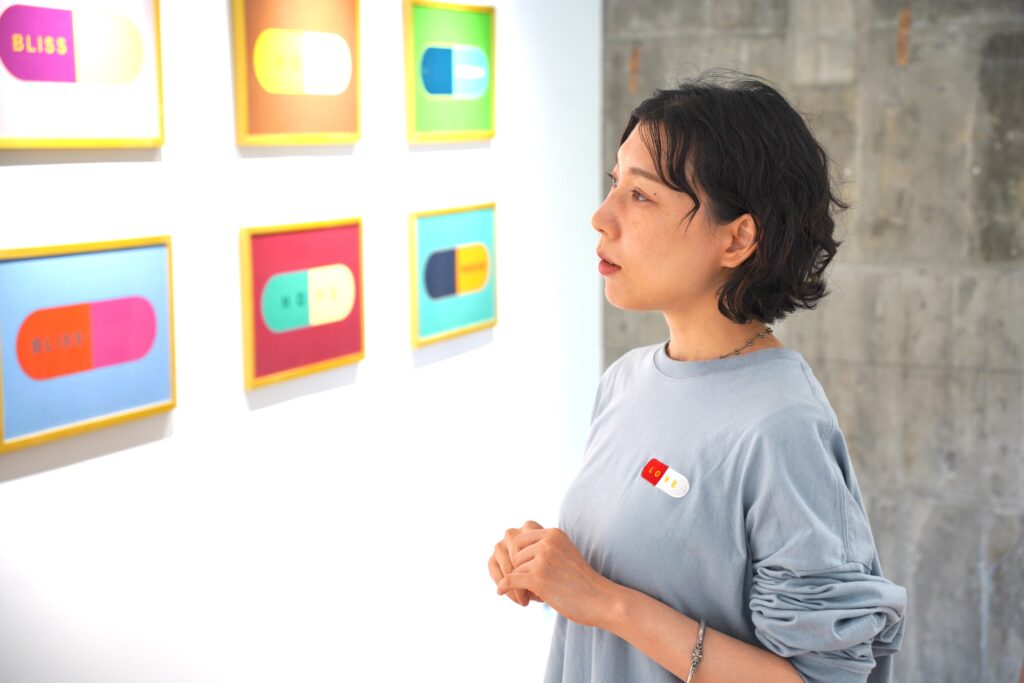
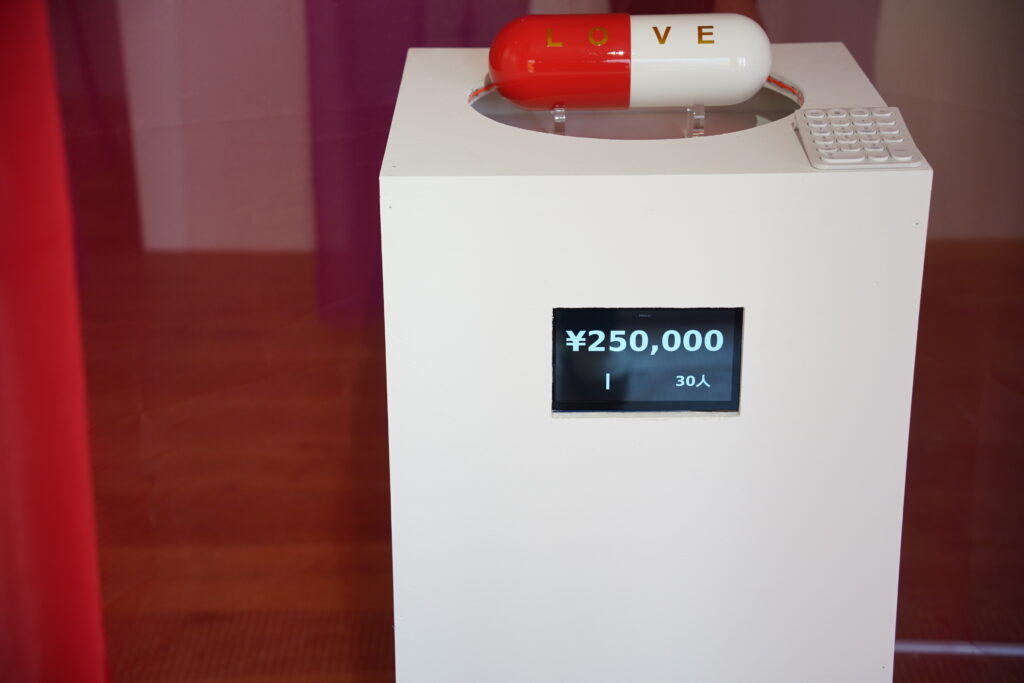
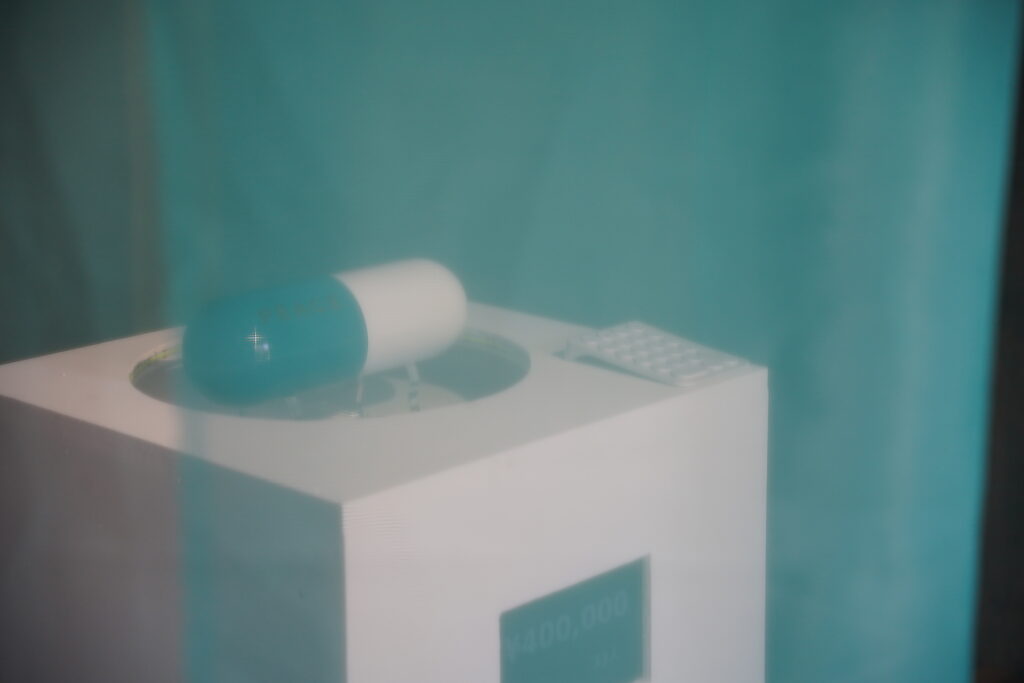
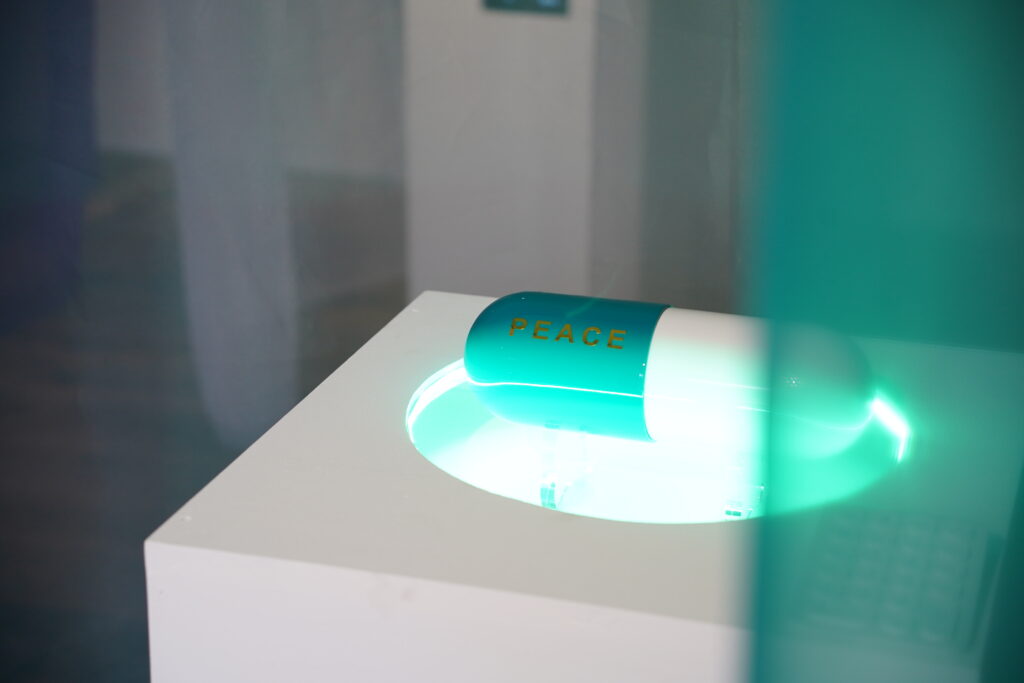
一方、西洋哲学者のドゥルーズは、価値や意味は世界の「外側」から与えられるのではなく、世界そのものの内部で生成されると考えました。東西それぞれの文脈で「内在」という概念は響き合っています。あなたの内側にあるエネルギーが誰かのエネルギーと重なり合い、作品の価値そのものを生み出していく——それが「collective immanence(集合的内在)」というタイトルと展示全体に込めた想いです。来場者一人ひとりが自分の内なるエネルギーをピルに注ぎ込み、値付けをすることで、「価値」というものが自分たちの中から生まれていくという体験を作りたかったんです。
The starting point of this theme is the idea that “what people seek outside themselves is already within us.” We tend to look to the outside world for things like love, peace, and enlightenment, but I feel that these can be found within each of us. In Eastern Buddhism, the Zen master Bodhidharma taught that “the Buddha is not outside, but within your own mind,” while Kūkai of Esoteric Buddhism preached that “one can become a Buddha just as one is.” On the other hand, the Western philosopher Deleuze believed that value and meaning are not imposed from “outside” the world, but are generated from within the world itself. The concept of “immanence” resonates across these Eastern and Western contexts. The energy within you overlaps with someone else’s energy, giving rise to the very value of the artwork—that is the sentiment behind the title “collective immanence” and the entire exhibition. I wanted to create an experience where “value” emerges from within the visitors themselves, as each person pours their inner energy into a pill and assigns a price to it.
Q:今回の個展ではソノアイダ#新有楽町で一緒に滞在制作された塩原有佳さんを呼ばれています。「Flowers for urban maladies 2.0」について教えてください。
In this solo exhibition, you invited Yuka Shiobara, with whom you previously created work during your residency at Sono Aida #Shin-Yurakucho. Could you tell us about Flowers for urban maladies 2.0?
A:有佳さんとは2022年のレジデンスで初めて一緒に制作をしました。あの時、わたしたちが選んだ「処方」という言葉には、現代社会の中で置き去りにされてきたものへの問いかけが込められていました。有佳さんの白地に白のメディウムで描かれた絵画のシリーズやパターンデコレーションに呼応する反復の力、また、私が都市空間でパフォーマンスを通じて蘇らせようとする気配のようなもの——二人の表現がとても自然に響き合った展覧会でした。あれから4年経った今、あの問いはまだ終わっていないと感じています。現代社会の中で取り残されていくものに眼を向けることは、むしろより切実になっている気がします。有佳さんの新作の壁画がこの空間に加わることで、問いがより立体的になっていると思っています。
I first collaborated with Yuka during the 2022 residency. At that time, the word “prescription” we chose was imbued with a questioning of the things left behind in modern society. It was an exhibition where our expressions resonated very naturally—the power of repetition in Yuka’s series of paintings and pattern decorations, rendered in white medium on a white background, and the kind of atmosphere I sought to revive through performance in urban spaces. Now, four years later, I feel that this inquiry is far from over. In fact, I feel that turning our gaze toward what is being left behind in contemporary society has become even more urgent. With Yuka’s new mural joining this space, I believe the inquiry has taken on a more three-dimensional quality.
Q:今回、来場者が作品に値付けを行う珍しい形をとった意図・理由を教えてください。
What was the intention behind the unusual format in which visitors assign prices to the works?
A:「価値」は誰がつくり、どのように決まるのか——そういう問いをずっと持っていました。ヨーゼフ・ボイスが「社会彫刻」という概念を提唱したように、一人ひとりの創造的な行為が作品の一部になる——そういう実験をしてみたかったんです。アーティストでもギャラリーでもなく、来場者自身のエネルギーを注ぎ込んだ値付けの中央値が販売価格になるという仕組みは、価値が外部から規定されるものだけではなく、内側からも生み出せるということの体現でもあります。
“Who creates ‘value,’ and how is it determined?”—I’ve always wondered about that. Just as Joseph Beuys proposed the concept of “social sculpture,” I wanted to conduct an experiment where each individual’s creative act becomes part of the artwork. This system—where the median price, determined by the energy contributed by the visitors themselves rather than by the artist or the gallery, becomes the selling price—embodies the idea that value is not merely something defined from the outside, but can also be generated from within.
Q:今回の展示作品で一番伝えたいことは何ですか?
What is the most important thing you hope to convey through the works in this exhibition?
A:ピルの前に立った瞬間に、ご自身の内側に意識を向けてみてほしいということです。愛のエネルギー、平和のエネルギー——それはすでにあなたの中にある。値付けが難しいと感じるなら、それはなぜなのかを丁寧に探ってみてください。その問いそのものが、すでにこの作品の一部です。
What I’d like you to do is turn your attention inward the moment you stand before the sculpture. The energy of love, the energy of peace—it’s already within you. If you find it difficult to put a price on it, please take the time to gently explore why that might be. That question itself is already part of this work.
Q:花崎さんはパフォーマンスを多くされてこられましたが、今回の展示、作品制作を経て、何か新しい気付きはありましたか?
You have created many performance works in the past. Through this exhibition and production process, did you discover anything new?
A:わたし自身がパフォーマンスをおこなうことも多いですが、パフォーマンスの基本である、身体・時間・空間を伴った鑑賞体験という意味において、今回は来場者の身体とエネルギーが主役になるような作品で、気付きが多いです。来場者一人ひとりがピルの前に立って、自分の内側と向き合う瞬間を見ていると、パフォーマンスをしている時と同じような、何か目に見えないエネルギーが動く感覚があります。エネルギーという捉えにくいものをメディアとして扱うというのも挑戦の一つでしたが、多くの人が手探りながらもまずはやってみてくださることで、その挑戦を可能なものとして実現してくださっている姿が印象的です。
While I often perform myself, in terms of the viewing experience—which involves the body, time, and space, the very foundations of performance—this piece, where the visitors’ bodies and energy take center stage, has taught me a great deal. Watching each visitor stand before the pill and face their inner self, I feel a sense of invisible energy moving—much like when I’m performing myself. Treating something as elusive as energy as a medium was a challenge in itself, but I’m deeply moved to see how many people, even as they feel their way through it, are willing to give it a try, thereby making this challenge a reality.
Q:今後の展望について教えてください。
Could you tell us about your future outlook?
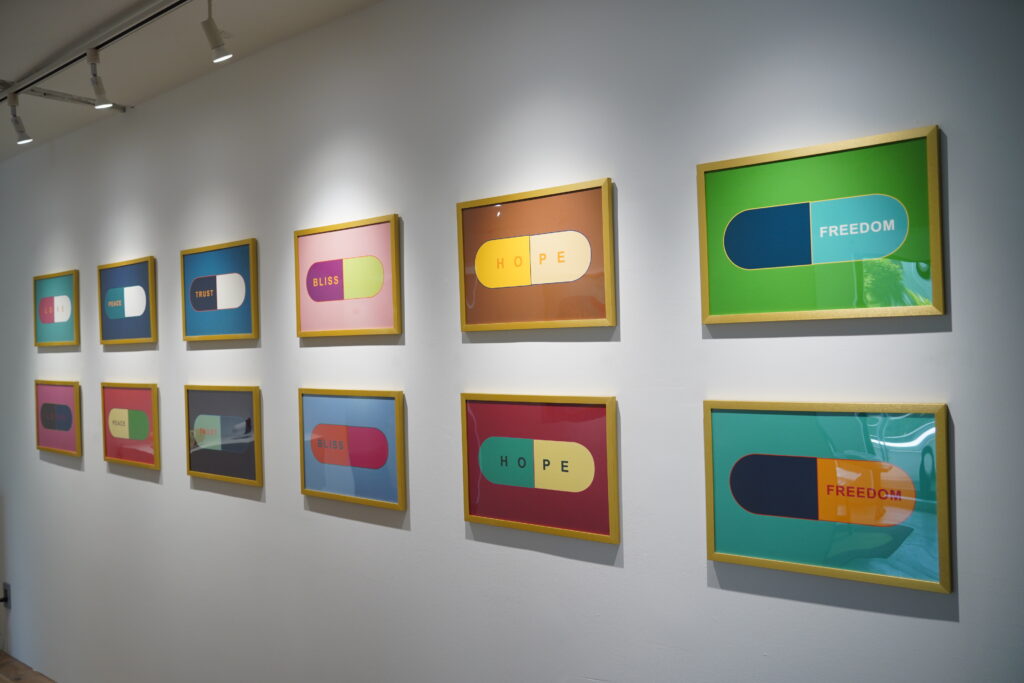
A:《PANACEA PILL》シリーズは、会期が終わってからも展開させていきたいと思っています。それぞれのエネルギーや値付けの経験は、その場所性や時代を反映するようにも思うので、フェアや海外で同じ作品を展示しても、また違った経験になるのではないかと予測しています。また、最近は「価値」や「エネルギー」、「単位」といった一見固定的に見えるが実は問い直せるテーマが気になっています。そういったテーマをさらに深め、活動していきたいと思っています。
I intend to continue developing the PANACEA PILL series even after the exhibition concludes. I believe that the unique energy and pricing strategies associated with each piece reflect their specific context and the times, so I anticipate that exhibiting the same works at other fairs or overseas will offer a different experience. Additionally, I have recently been interested in themes such as “value,” “energy,” and “units”—concepts that appear fixed at first glance but can actually be reexamined. I hope to further explore these themes in my future work.
アーティスト:塩原 有佳へのインタビュー
Q: 自己紹介をお願いします。
Please introduce yourself.
A:平面作品を中心に制作活動しています。近年では日々生きていくなかで生じる疑問や、様々な事象が孕む可能性についての考察を起点として、物理学、量子力学、天文学、あるいは過去に証明されてきた学問的知識を手がかりに、存在の有無、自己と他者の境界、生と死のあいだ、時間、思考、意識、認知、視覚からの影響、そして無限後退していくスケールや世界のあり方を捉え直し、そうした考察に独自の解釈を加え、科学の図式や図鑑のように、言葉を介さず伝えられるよう図式化を試みています
I primarily create two-dimensional works.
In recent years, starting from questions that arise in daily life and reflections on the possibilities inherent in various phenomena, I use physics, quantum mechanics, astronomy, and previously proven academic knowledge as clues to re-examine the existence or non-existence of existence, the boundary between self and other, the space between life and death, time, thought, consciousness, cognition, the influence of vision, and the infinitely receding scale and nature of the world. I add my own interpretations to these reflections and attempt to diagram them in a way that can be conveyed without words, like scientific diagrams or atlases.

Q: 今回の個展ではソノ アイダ#新有楽町で一緒に滞在制作された花崎さんの展示内で作品を発表してくださいました。この展示「Flowers for urban maladies(都市に処方する花束) 2.0」について教えてください。
In this solo exhibition, you presented your work within the exhibition of Ms. Hanazaki, with whom you collaborated on a residency at Sono Aida #Shin-Yurakucho. Could you tell us about this exhibition, “Flowers for urban maladies 2.0”?
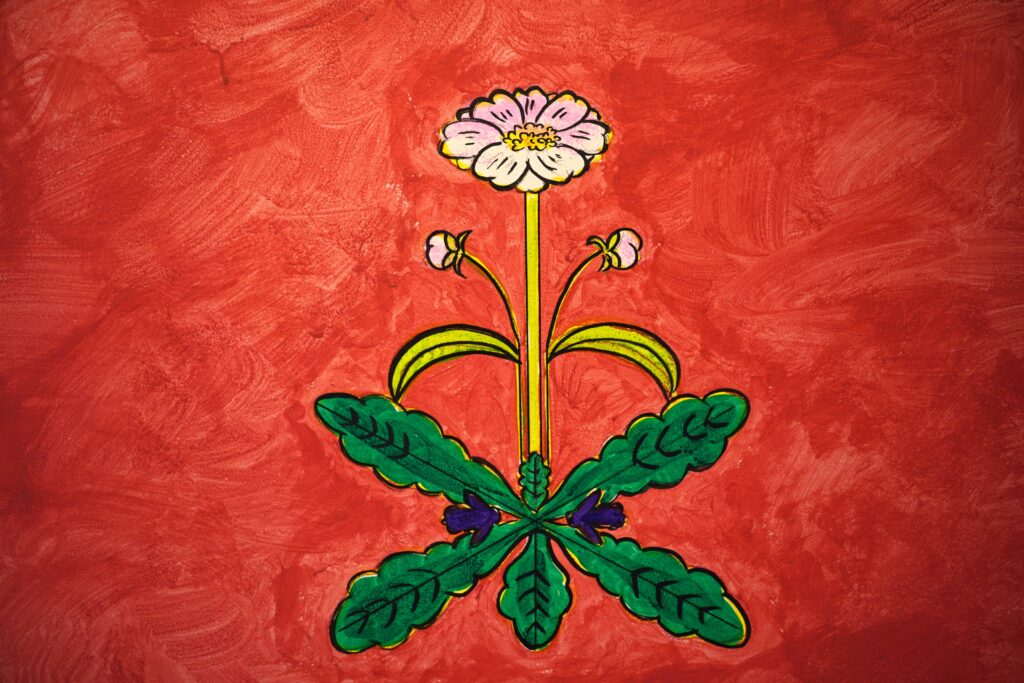
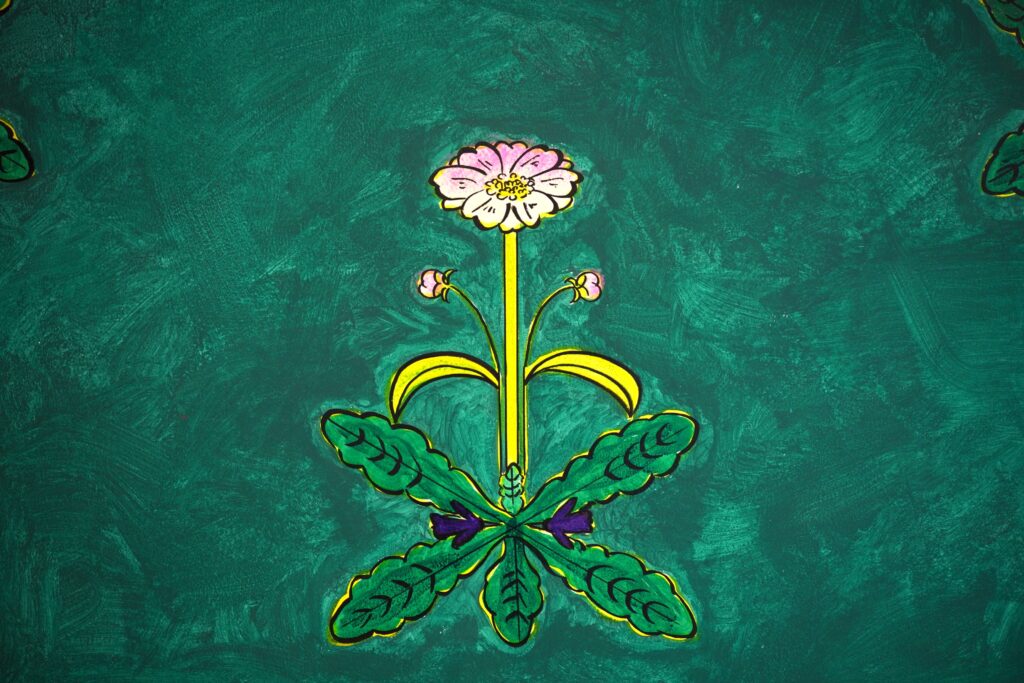
A: 2022年の「Flowers for urban maladies」では、花崎さんやソノアイダのメンバーと対話を重ねるなかで、今回の展示を形づくるうえでお互いに大切にしている感覚や価値観について、とにかくたくさんの言葉を挙げていきました。そのなかで、「ケア」や「処方」という言葉がキーワードとして上がってきました。そこから、メインビジュアルとして“万能薬の花束”というイメージを着想し、実際に漢方などにも用いられる芍薬やキランソウをモチーフとしてパターン化し、作品へ取り入れました。
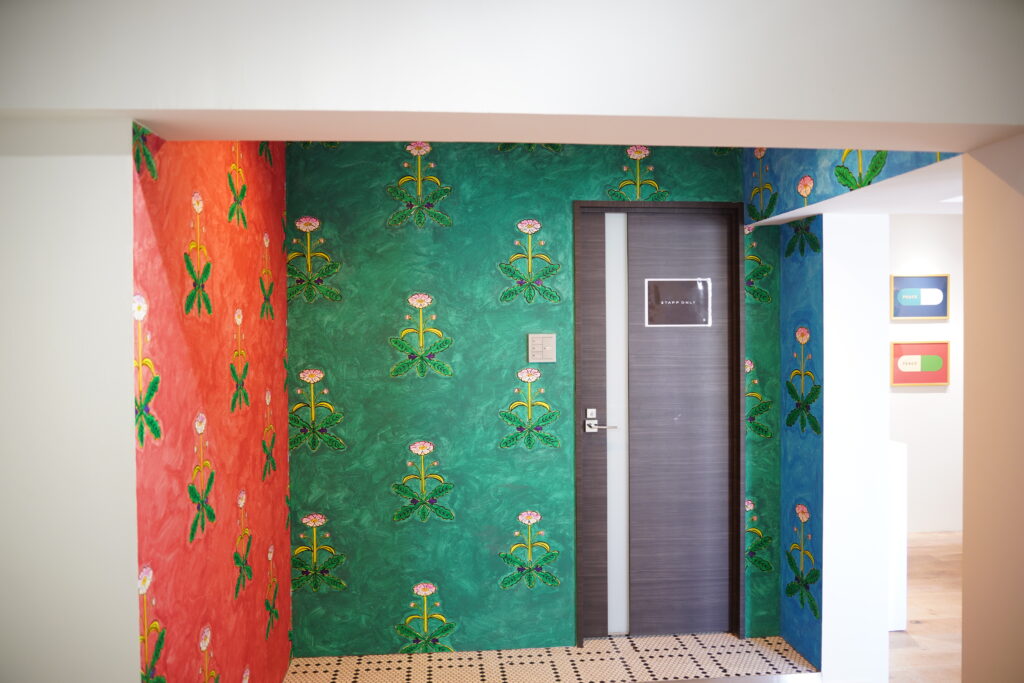
パターンを絵画の一要素として使用する手法は以前から自身の制作の中で用いており、本来絵画の中で主役とされるモチーフを目立たせず、副次的に使用される装飾的要素を反復されるパターンとして強く印象づけることで、モチーフ同士の主従関係を反転させることを試みています。
またパターンの一つひとつを手描きすることで、「同じように見えて異なる」そして逆に「異なるものでも、距離や視点が変わることで同じように見える」ことへの感覚も内包しています。
「Flowers for urban maladies 2.0」ではモチーフ自体は引き継ぎつつ、芍薬やキランソウが持つ植物としての特徴を、より強く反映させることを意識しました。 さらに今回は、花崎さんの個展プランを伺うなかで、空間そのものに花束のモチーフを反復させることで、「ENERGY DOSE」と親和性を持ちながら共存できるのではないかと考え、壁画制作にも挑戦しました。
For the 2022 exhibition “Flowers for Urban Maladies,” through repeated discussions with Ms. Hanazaki and the members of Sonoaida, we listed countless words that represented the sensibilities and values we all held dear in shaping this exhibition. Among them, the terms “care” and “prescription” emerged as key concepts. From there, I conceived the image of a “panacea bouquet” as the main visual. I created patterns based on peonies and goldenrod—plants actually used in traditional Chinese medicine—and incorporated them into the artwork.
I have long employed the technique of using patterns as an element of painting in my own work. By downplaying motifs that are typically the focal point of a painting and instead emphasizing decorative elements—which are usually secondary—as repeated patterns, I attempt to invert the hierarchical relationship between motifs.
Furthermore, by hand-drawing each individual pattern, the work embodies the sensation that “things that look the same are actually different,” and conversely, that “even different things can appear the same depending on distance or perspective.”
In “Flowers for urban maladies 2.0,” while retaining the motifs themselves, I focused on more strongly reflecting the botanical characteristics of peonies and goldenrod. Furthermore, while discussing Ms. Hanazaki’s solo exhibition plan, I considered that repeating the bouquet motif within the space itself might allow the work to coexist harmoniously with “ENERGY DOSE,” so I also took on the challenge of creating a mural.
Q: 絵画作品や額縁に4色の色が使用されていますがその意図や意味を教えてください
Four colors are used in the paintings and frames. Could you please explain the intention or meaning behind this?
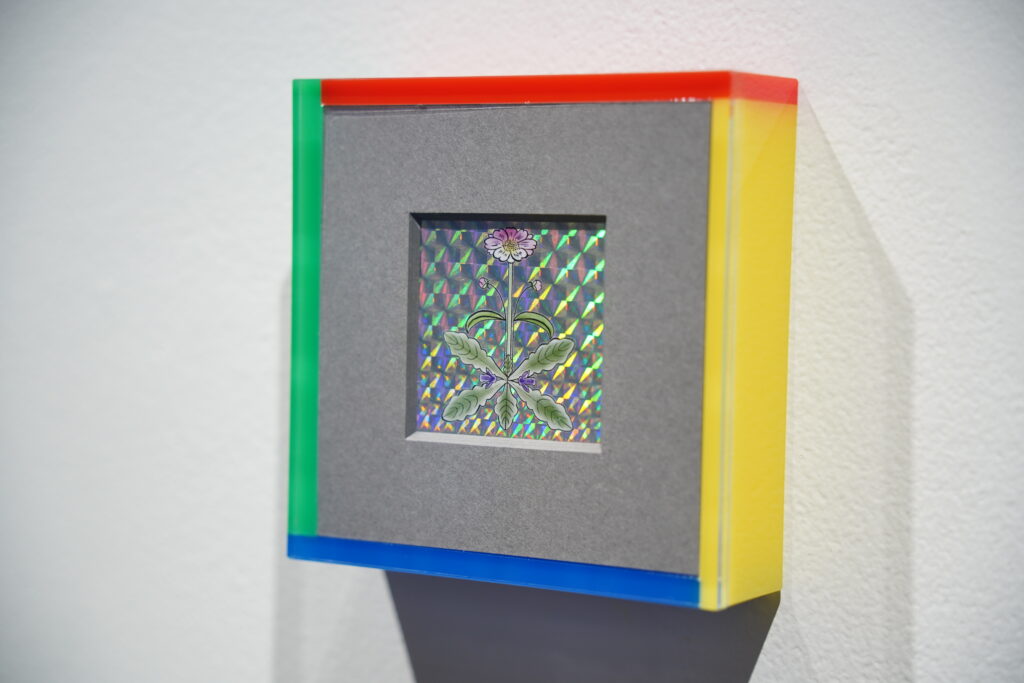
A: 2022年に制作した絵画作品や、今回のドローイングの額装作品では、縁を囲うように赤・黄・青・緑の4色を配置しています。これは四大元素をイメージしたものであり、絵画という四角い区切りのなかに、一つの世界が広がっているような感覚を表現しています。
また、今回のドローイング作品では、鑑賞者自身が額縁を選択できる形式にすることで、作品との関係性や距離感を能動的に決定できる余地を持たせたいと考えました。額縁は単なる装飾ではなく、作品と空間、あるいは鑑賞者との境界を定義する要素でもあるため、その選択行為自体も作品体験の一部になることを意図しています。
In the paintings I created in 2022 and the framed drawings in this exhibition, I have arranged four colors—red, yellow, blue, and green—to encircle the edges. This arrangement is inspired by the four classical elements and expresses the sensation that a whole world unfolds within the square confines of the painting.
Furthermore, with these framed drawings, I wanted to give viewers the freedom to actively determine their relationship with and distance from the work by allowing them to choose the frame themselves. Since the frame is not merely a decorative element but also defines the boundary between the work and the space—or the viewer—I intended for the act of selection itself to become part of the experience of the work.
Interviewer : Satoko Kubota